AiRethink
A Community Answer to Corporate AI
See Related Papers and Related Projects:
Semantic Meaning & Analysis AI Modeling Thought & Language AI Affective Virtual Human
XR Avatars; Edu, Coaches, Health Sensing Humans (Bio/Brain/Face/Movement/VR)
Researchers: Steve DiPaola, Vanessa Utz, Rafael Arias Gonzalez Funders: SSHRC Insight Grant 2026–2030
Rethinking what AI should be: local, open, human-led, and owned by no one but you. Ai Rethink is a research initiative building a full-stack alternative to corporate AI - free and unlimited systems that run privately on your own computer, on open models and open tools, with the human, not the cloud, in charge.
The Problem
What is wrong with AI today and who gets to fix it?
Corporate AI has one architecture: your words travel to their servers, their model answers, and everything about the exchange belongs to them — your data, the running cost, the model, and the rules. From that single design choice, the familiar problems follow.
Privacy. Your prompts, documents, and creative work are routed through corporate infrastructure under terms you don't set and can't renegotiate.
Access. Subscription walls and rate limits price out students, non-profits, Indigenous communities, and cultural organizations — the very groups with the most to gain
Energy. Cloud inference consumes energy at a scale that meaningfully harms the climate, and none of that cost is ever shown to the person incurring it.
Data taken without consent. The dominant models were trained on copyrighted and culturally sensitive works, with no attribution and no provenance.
Cultural flattening. A graduate student in our lab, studying Chinese art conservation, fed traditional Chinese scroll paintings into a leading commercial model and received output shaped by modern Japanese aesthetics. That is not a glitch; it is Western-dominated bias baked in at the data level, and Indigenous and non-Western traditions are harmed most.
Passive use. The "you prompt, AI produces" pattern erodes the reasoning, questioning, and synthesis of the people who use it — and, in creative fields, displaces the artist from their own process.
Two Projects — One Unified Mission
Same Foundation, Two Layers
The two projects share the foundation above but attack different layers of the AI stack and, to our knowledge, no one else is rebuilding both. Open infrastructure answers "how do you run AI without corporate capture?" A new model answers "is what's inside the model ethical?" You need both.
Project 1
Uness (uness.org)
The Knowledge Layer — LLM / Text AI
A fully open-source, locally-run AI system. Free, private, no cloud, no subscription. Runs on your Mac or PC. Designed for deliberate, human-led use.
Status: v4.0 deployed
Students · educators · non-profits · Indigenous groups · cultural institutions
Project 2
The Hilma Project
The Creative Layer — Visual / Image AI
A new visual generative model built from ethically sourced data, with culturally grounded captioning and a Creative Journey interface that puts artists in control.
Funding: Large 5 year SSHRC Insight Grant
Artists · designers · cultural institutions · Indigenous communities
Uness takes its name as a phonetic play on Eunice, for Eunice Newton Foote, whose 1856 experiments first showed that CO₂-rich air traps heat, an early articulation of the greenhouse effect; her paper was read at the AAAS meeting by a male colleague, and her insight went uncredited for over a century, making her name a fitting choice for a system built around environmental transparency and returning control to the people usually left out.
The Hilma Project, its companion, is named for Hilma af Klint, the pioneering abstract painter who worked outside the commercial art market and went unrecognized for decades, echoing Foote's own erased history. Funded by a major five-year SSHRC Insight Grant (2026-2030), Hilma reorients visual generative AI to protect and empower artists and cultural communities rather than displace them.
Project 1
Uness: The Knowledge Layer
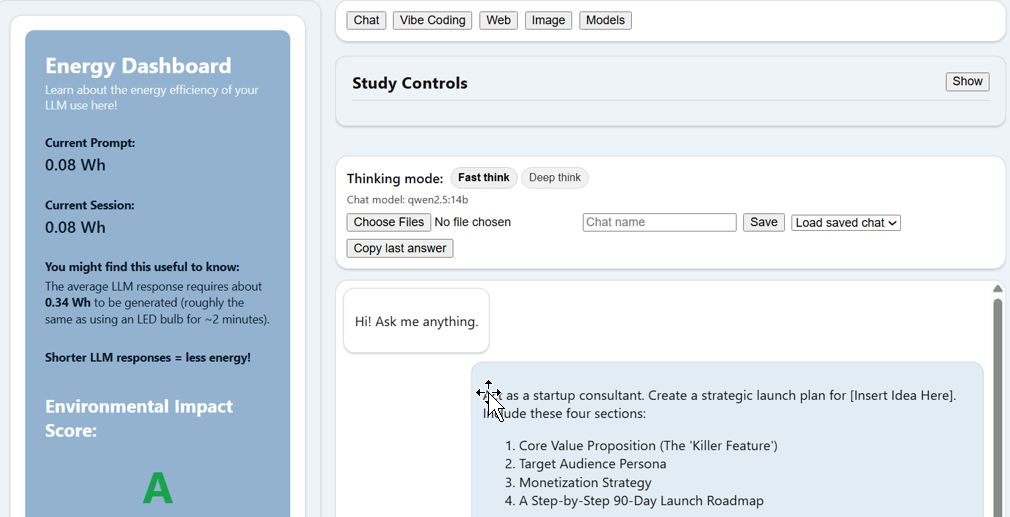
Uness is our fully open-source, locally-run LLM system for reflective knowledge work: free, unlimited, and private, designed to democratize access to AI and shrink the digital divide.
Runs on your machine. A single mid- to high-end consumer Mac or PC. No cloud dependencies, no logins, no costs; your conversation history stays on your own file system.
Open, modular models. You choose the distilled open model that fits your hardware and your energy goals — smaller for light tasks, larger when the work demands it.
Built for orchestration. Web research, reasoning, and document knowledge (PDF, DOCX, TXT) are deliberately separate tools you invoke on purpose — human-in-the-loop by design, with live efficiency tips as you work.
Deployed now. v4.0 is in real use with students, researchers, and community partners — from Indigenous knowledge projects and medical education to Chinese art conservation and animal communication research.
Learn More: uness.org
Project 2
RethinkAI: The Creative Layer
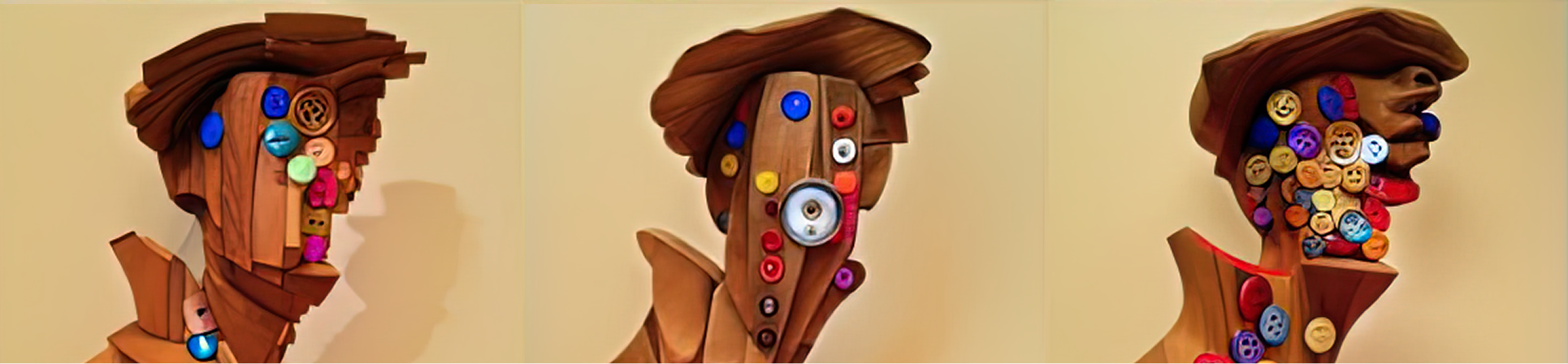
A new visual generative model built from ethically sourced data, with culturally grounded captioning and a Creative Journey interface that puts artists in control. AI ReThink fundamentally reorients visual generative AI to protect and empower artists and cultural communities rather than displace them.
Artists have always pushed at the material boundaries of their craft, from the move to oil paint, to the camera, to digital tools and generative code. Each shift was resisted, absorbed, and eventually became its own vocabulary in the hands of practitioners who took it seriously. We see AI the same way: not as a replacement for human creative labor, and not as something to adopt wholesale because it exists, but as a new medium whose material properties artists are still discovering. The question worth asking is not whether AI belongs in the studio, but on whose terms, with what materials, and toward what ends.
Why a New Model, Not Just a New Interface
Today's image models were trained on copyrighted and culturally sensitive work taken without consent, captioned by systems that flatten cultural and aesthetic distinctions, and tuned toward a pop-commercial center of gravity. Every artist who uses them feels the pull: outputs drift toward the same polished, Western, market-tested look. For an artist trying to reach what is in their own head and heart, that gravity is hard to escape, the model keeps dragging the work back toward everyone else's. Fixing this requires going below the interface, to the data and the model itself. We are doing that across three objectives.
1 An Ethically Sourced Dataset and a New Model
A new visual generative model trained exclusively on pre-1932 public domain artworks and design works — legally clean and fully documented, with special emphasis on Canadian and Indigenous artistic traditions. Every source, artist, and image will be publicly searchable. Provenance is not an afterthought; it is a design requirement.
2 Culturally Grounded Captioning
A semantic captioning and retraining system built with Indigenous communities, Asian cultural experts, dance and movement practitioners, designers, and other domain experts. The goal: captions that preserve cultural specificity, art-historical knowledge, stylistic nuance, and technical execution — instead of erasing them. We are actively seeking faculty collaborators across traditions to help build this "Culture Caption" framework.
3 The Creative Journey Interface
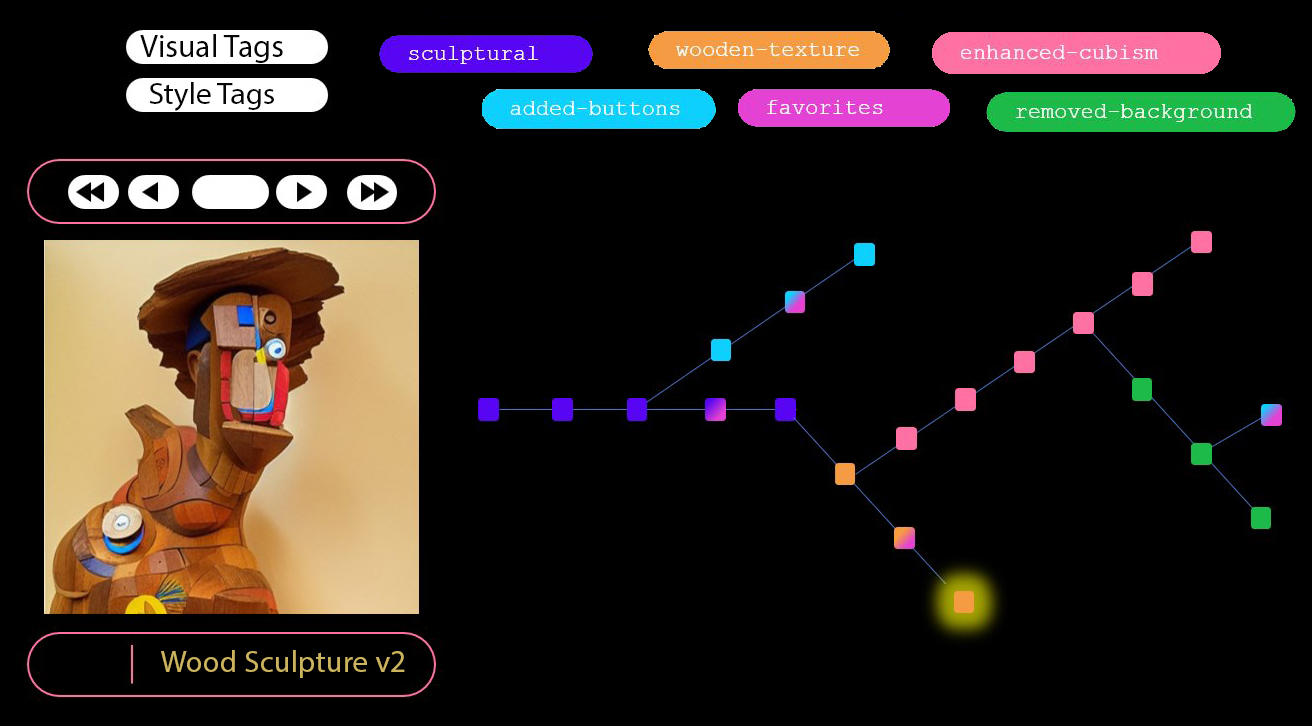
Artists don't prompt in the real world; they journey. Hilma maps every step of a creative session and makes that map visible and navigable: move forward, return to an earlier branch, label, fork in a new direction, and see the whole territory of your own creative process. Session-specific personalization adapts the model to the artist's emerging direction — toward their vision, not the market's. Human-in-the-loop throughout, running locally, with the energy dashboard integrated so artists see the cost of every session.
One Foundation, Three Commitments
Everything we build, both projects, every tool, rests on the same three commitments, in this order.
1 Ownership — Free, Local, Private, Unlimited
This is the base condition for everything else. Our systems run entirely on your own computer, on open models and open tools. No cloud, no login, no API key, no subscription, no rate limit. Your prompts, your documents, and your creative work never leave your machine — which means there is nothing for a company to collect, mine, or monetize. AI you can actually own, on hardware you already have.
2 Orchestration — Humans Conduct, AI Plays a Part
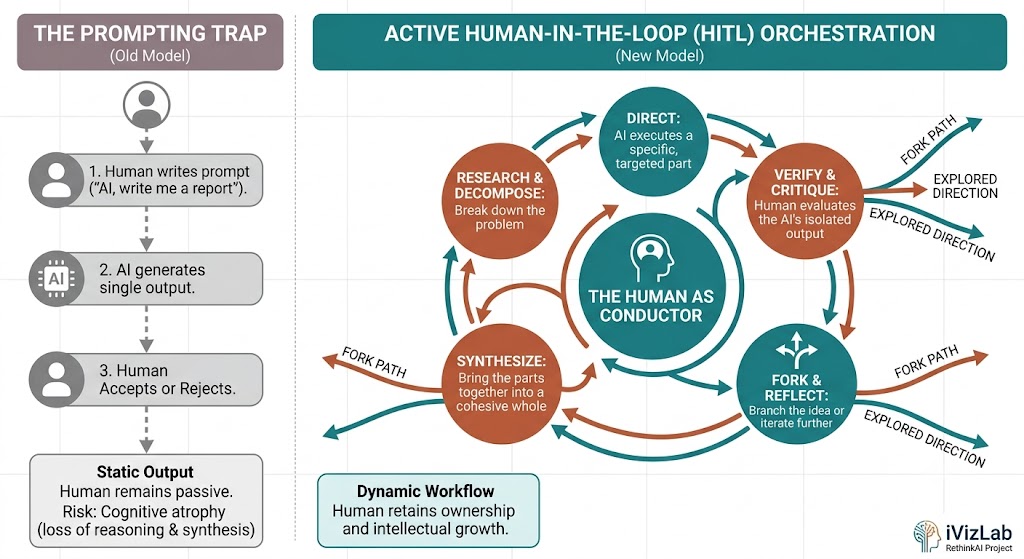
We are moving away from the "you prompt, AI produces" trap. Passive prompting leads to cognitive atrophy: the slow erosion of reasoning, questioning, synthesis, and reflection. Real professional and creative work is never one-shot — so our systems are built for active orchestration. You decompose the problem, direct each step, verify the output, then fork, reflect, and continue. You are the conductor; AI executes a part. This human-in-the-loop philosophy shapes the interface of both projects.
3 Sustainability — Energy You Can See and Manage
Running locally already cuts energy use to a fraction of cloud AI: our measured 0.13 watt-hours per query, against an estimated 20–50 watt-hours for GPT-5. But we go further. Both tools include a real-time energy dashboard, so the environmental cost of every prompt and every session is visible as you work. Our published user studies show that this visibility changes behavior — people query more deliberately when they can see the cost.
------ PAPERS: AI Rethink ------
International Conference on Machine Learning (ICML) 2026
International Joint Conference on Artificial Intelligence (IJCAI)
Journal of Perceptual Imaging (2025)
ACM CHI Conference on Human Factors in Computing Systems (CHI) (2025)
ACM CHI Conference on Human Factors in Computing Systems (CHI) (2024)
NeurIPS 2024, NeurIPS Workshop on Creativity & Generative AI (2024)
ACM CHI Conference on Human Factors in Computing Systems (CHI) (2024)
Conference on Computer Vision and Pattern Recognition (CVPR) 2023 (2023)
International Conference on Computational Creativity (2023)
ACM Conference on Computer Supported Cooperative Work and Social Computing (CSCW) (2021)
Biologically Inspired Cognitive Architectures (BICA) (2019)
Affective Computing and Intelligent Interaction Workshops and Demos (ACIIW) (2019)
Biologically Inspired Cognitive Architectures (BICA) (2019)
Annual Conference of the Cognitive Science Society (2019)
International Conference on Artificial General Intelligence (AGI) (2018)
Full Book (2016)
Biologically Inspired Cognitive Architectures (BICA) (2014)